GridScore™ · Grid Intelligence Workspace
Find better grid connection opportunities. Faster.
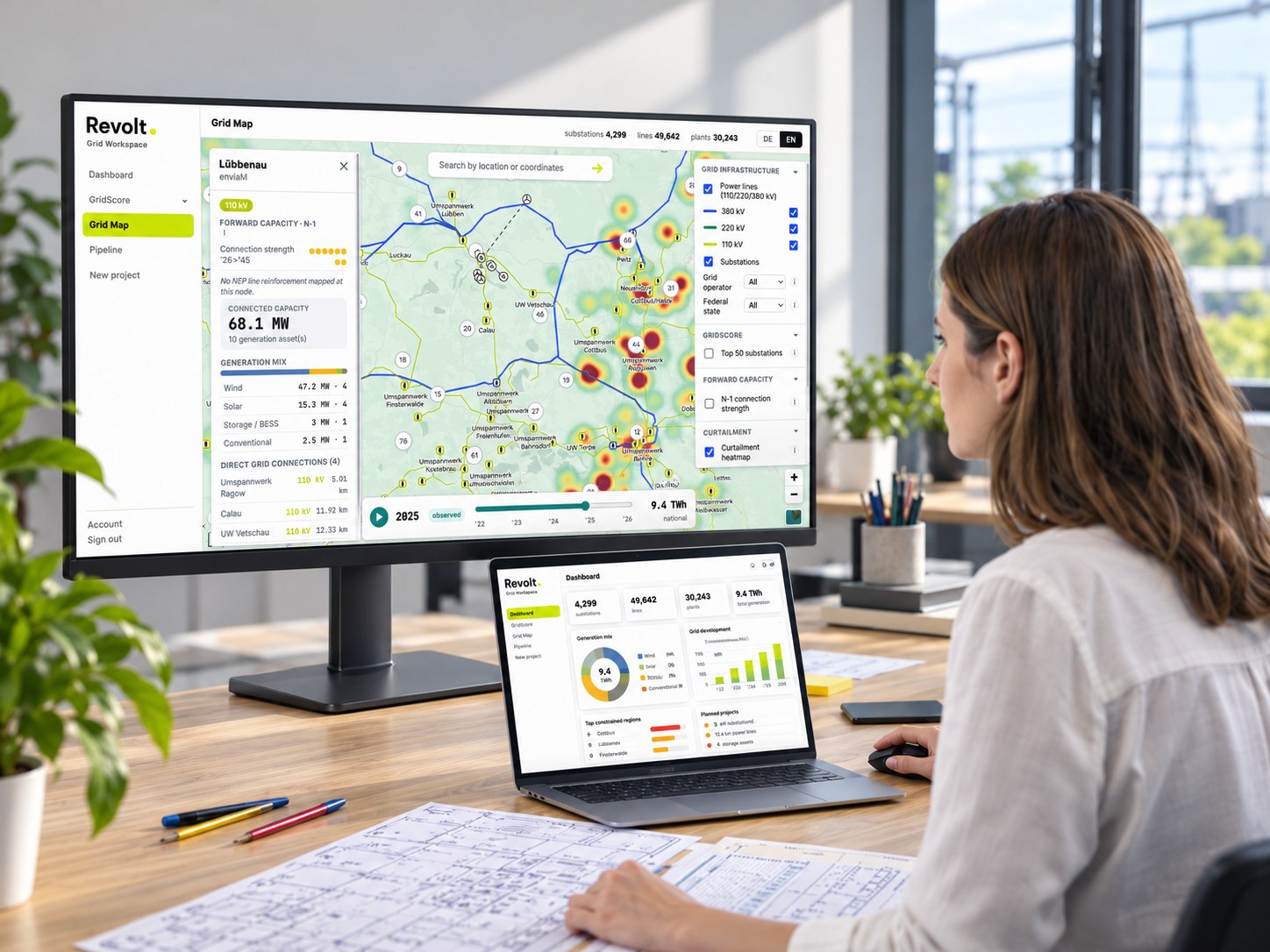
Screen, compare and prioritize BESS development sites across Germany — grid constraints, curtailment exposure, network build-out and connection timing in one workspace.
Analysis Framework
What GridScore does
-
Automated technical assessment of substation capacity and network constraints across German electricity networks.
-
Analysis of redispatch exposure, curtailment risk, and regional network constraints for BESS and flexible assets.
-
Prioritization of candidate connection points based on grid-related investment and development risk.
4.3k
Substations in the workspace
12GW+
Projects analyzed
>94%
Grid coverage
380 | 110 kV
Voltage levels
What you can do
From grid data to
better project decisions
Identify and compare connection opportunities
Explore substations across Germany, assess available grid capacity indicators and compare potential connection locations.
Understand grid congestion and curtailment exposure
Review historical congestion and redispatch patterns to identify network constraints that may affect project performance.
Track grid expansion plans and timelines
Explore planned network reinforcements, including relevant measures from Germany's Network Development Plan (NEP).
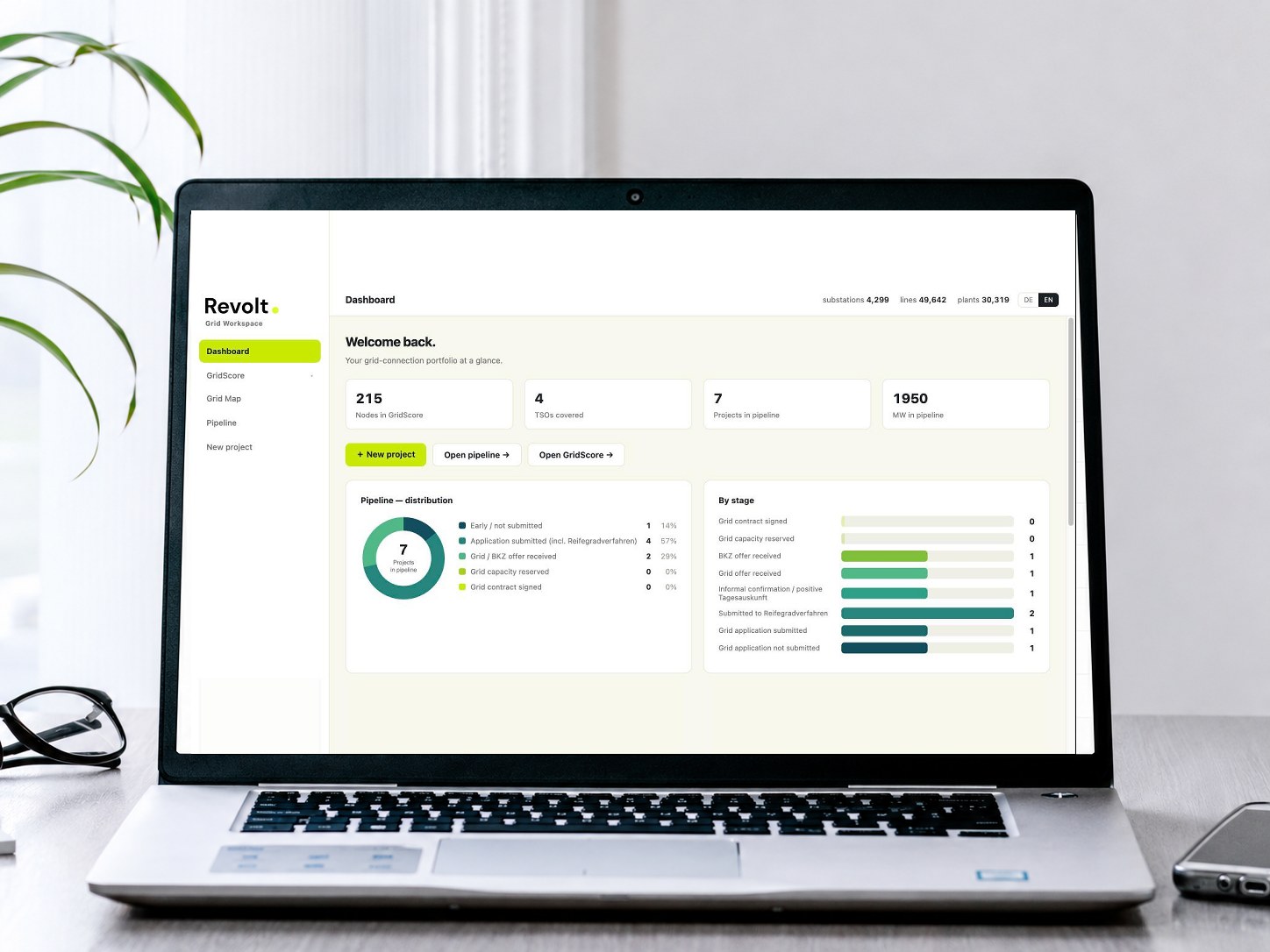
Prioritize your development pipeline
Compare substations using GridScore's scoring and track candidate sites through the connection process.
Beyond the Score
When a project needs more than a score
GridScore supports screening and prioritization. For investment decisions, project-specific assessments or complex connection questions, Revolt provides independent analysis and specialist grid advisory.
Grid risk assessment
Independent, project-specific analysis of congestion, curtailment and network constraints affecting a site.
Connection strategy & process support
Guidance through TSO and DSO application processes, Reifegradverfahren and connection negotiations.
Acquisition & pipeline screening
Early-stage support for project selection, portfolio prioritization, and grid-related development risk.
FAQ
Common questions
Where does the data come from? +
Exclusively from official, publicly accessible sources: redispatch measure lists from Netztransparenz.de at TSO level and official DSO publications at distribution level; the Marktstammdatenregister (Bundesnetzagentur) for plants and grid connection points; the Netzentwicklungsplan project library (netzentwicklungsplan.de) and BNetzA's netzausbau.de monitoring for grid build-out; the grid operators' published connection-capacity indications; and SMARD and Regelleistung.net market data for revenue context. Grid mapping builds on OpenStreetMap data (© OpenStreetMap contributors). Every figure in the workspace traces to its source.
Does GridScore guarantee grid capacity at a substation? +
No. GridScore supports early-stage screening and prioritization. Binding capacity confirmations only come from the relevant grid operator through the formal connection process; GridScore helps you decide where that process is worth starting.
What does GridScore cover? +
Germany's 380 kV transmission network across all four TSO regions, with progressive expansion into the 110 kV distribution grid. The availability and precision of individual indicators depend on what the relevant grid operators publish.
Who is it for? +
BESS developers and investors managing multiple development opportunities — screening new sites, prioritizing an existing pipeline, or evaluating projects for acquisition.
Can Revolt look at a specific project in depth? +
Yes. Project-specific grid risk assessments, connection reviews and strategic support are available through Grid Advisory, independently of a GridScore subscription.
Make your next grid connection decision with better intelligence.
See GridScore on your own development pipeline, or discuss a project-specific grid assessment.